1980s Vintage Computers
Apple II computers
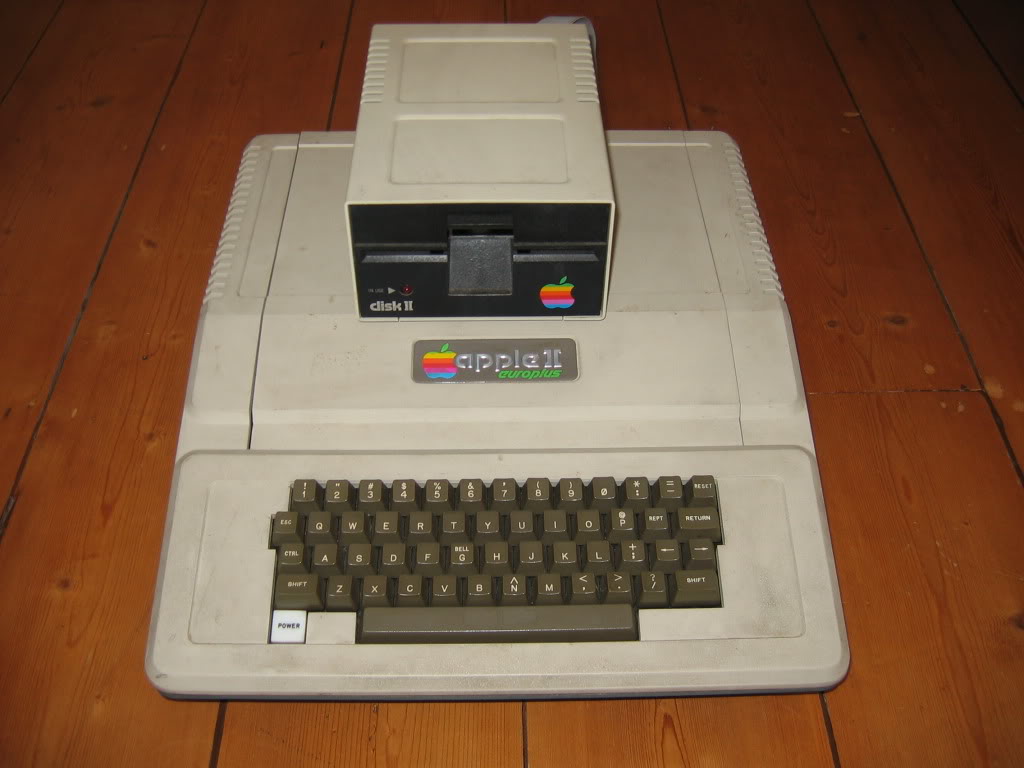
Apple started off in the micro computer world as members of the Home brew computer club in 1975, as described in Steven Levy's book Hackers. Their first computer in 1976 was the bare board Apple I, sold to mainly hobbyists in limited numbers. Steve Jobs saw the market for a computer in a stylish case with built in power supply, keyboard and processor, which would connect to a monitor or TV as the display, with colour graphics, and using a cassette player for tape storage. This was the original Apple II computer, which launched in 1977 with a minimal integer Basic; a floppy disk drive (the Disk II) quickly followed in 1978. Some Apple II computers found their way to the UK, along with the improved Apple II plus (or II+) but it was the Apple II Europlus (shown above along with the Disk II floppy disk drive) that was the first Apple computer produced in 1979 for the European market.
The specification of the II Europlus is:
- 6502 8-bit processor running at 1MHz (approximately).
- 16KB to 48KB RAM (socketed for easy expansion), 8KB ROM for Applesoft Basic (based on Microsoft floating point Basic), 2KB ROM for system routines including cassette annd disk handling, and one empty socket for an additional 2KB ROM.
- Runs Apple DOS 3.3 from floppy.
- Cassette port, video port (monochrome text and graphics only without additional PAL colour card).
- Eight expansion slots for Apple or third-party cards, e.g. the Disk interface card.
- Joystick port (DIL socket on motherboard).
- Built in speaker.
The Apple II disk interface and Disk II disk drive were designed to use far fewer chips than those in other personal computers of the time (eg less than an S100 bus floppy interface card and Tandon TM100 floppy drive). The floppy disk was written using a custom Apple format, which featured Group Coded Recording (GCR) which needed less circuitry.
A huge amount of software was written for the Apple II, ranging from games, educational software and business applications. The VisiCalc spreadsheet was the 'killer app' which led to Apple II use in business - also its high price compared to other microcomputers limited sales to home users outside of the US.
I have several Apple II compatible cards, these include:
- Apple Disk interface card which supports one or two Disk II floppy drives.
- Apple Super Serial card, provides an RS232 port which works well with the ADTPro software for copying software from a PC.
- Stellations the Mill 2 6809 processor card.
- Microsoft Z80 SoftCard, which has uses the Apple II RAM and allows CP/M to be run.
- Apple 16kB language card, expanding the total RAM to 64KB.
- Apple ROM card. This has sockets for 16KB of ROM or EPROM, e.g. to allow both Integer Basic and Floating Point Basic to be available (switchable).
- Parallel printer port card.
This page was last revised on:4/10/25