1980s Vintage Computers
Acorn Archimedes A4000
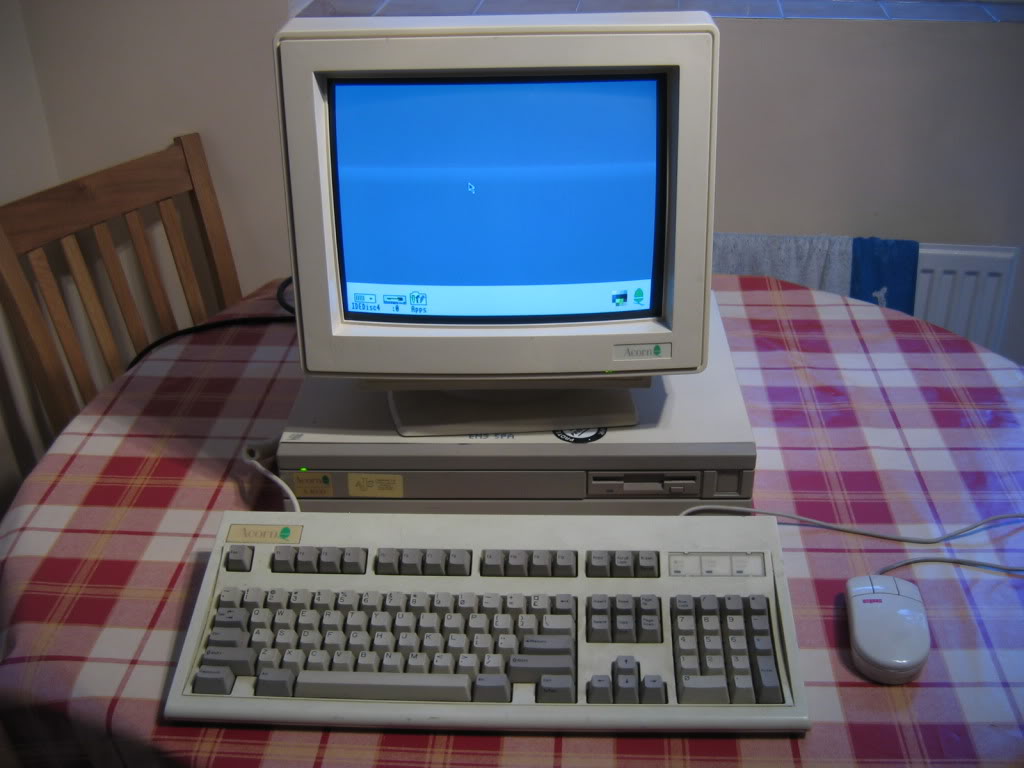
After the BBC Master Acorn took their ARM RISC processor and built a computer around it, the result was the Acorn Archimedes. The A300 and A400 models came first in 1987, I had an A4000 which came much later in 1992. This runs RISC OS version 3.11, which shares a lot of features from the BBC Master MOS operating system, and allows limited emulation of the BBC Micro. A lot of school based software for the BBC Micro was ported over to the Archimedes, as well as new applications to take advantage of the graphical user interface and more powerful processor of the newer machines.
The specification of the the A4000 are:
- ARM 250 32-bit processor running at 12MHz.
- 2MB RAM (expandable to 4MB).
- 2MB ROM containing RISC OS 3.11 and some desktop applications.
- Colour graphics at a range of resolutions up to 800x600 on a VGA stye connector..
- Built in 3.25" floppy disk drive, up to 1.6MB capacity but able to read BBC Micro DFS or ADFS disks as well as DOS 720K and 1.44MB disks.
- 80MB IDE hard drive.
- External keyboard similar to IBM PS/2, this contains a port for a 3-button bus mouse.
- Parallel and serial (RS423) interfaces.
- 8 channel sound, mono speaker and stereo output socket.
- Support for add-on modules eg for networking.
The A4000 was the last in the Archimedes range, Acorn went on to release the Risc PC and A7000 series up until 1997. The RISC OS family of 32-bit ARM computers built up a loyal base of customers and fans, and companies such as Castle and Iyonix launched new compatible machines. RISC OS was developed further and is still available today for modern ARM based computers such as the Raspberry Pi.
This page was last revised on: 3/06/26